Growth mania v Jugaad
“Development that has gone rogue pushes India into growth mania. It needs to be discarded to prevent future catastrophic events and reduce the nation’s vulnerability, especially that of its poor.’
Professor Arun Kumar, specialist in development economics, writing in 2023
‘ At the heart of the Hindi word jugaad is frugality, intelligence and imagination used to find a solution to any problem.’
One definition of an almost untranslatable word.
It is always, always, worth making a journey into Bihar and reconnecting with its people.
Even when I know we will travel through an unrelenting summer heatwave.
Even when I know that events have tipped the balance against the poorest people and presented new challenges for all our affiliated eye hospitals who work with them.
I expected to have to boost morale. I returned boosted by what Biharis are so good at displaying – jugaad.
A recent state election had placed Prime Minister Narendra Modi’s BJP Hindu nationalist party finally and firmly in control of Bihar.
Former Chief Minister, Nitesh Kumar, who had more or less ruled the state for two decades, had been pensioned off to the Lok Sabha, the Indian House of Lords in New Delhi.
(In passing – he was no saint, but I experienced the results of two good things that Nitesh Kumar managed to do: he massively improved Bihar’s notorious law and order situation and gave every girl a bike. I remember village girls turning up on those new pink bikes to play football with me at 5am).
Anyway that’s old hat now. PM Modi’s development agenda centres around ‘a 21st century driven by technology’ and business-orientated solutions to even health and social problems.
A few days before we set foot on Bihari soil, Indian billionaire Gautam Adani (who recently settled a civil fraud case against him and his nephew in the USA by investing $18billion in that country) showed up in Saran district, Bihar.
He was there to inaugurate the Adani Akhand Jyoti Eye Care Hospital at Mastichak.
The Adani Foundation website announced that Mr Adani was to invest 150 crore rupees -that’s around £20million - in this eyecare initiative.
Curious. Because everyone in Bihar knows that this hospital is already as rich as Croesus - although perhaps not on par with Adani (!) who is heading to be India’s first trillionaire.
Less than 3 years ago the Shankara Eye Foundation USA – self-proclaimed ‘world’s largest free eye care service’ – funded the construction of a new 500 bedded hospital on the same site. Nor do they seem to want to be upstaged by Mr Adani. They promise a new 1000 bed eye hospital with 20 operating theatres ‘to be completed by 2027’.
There is now even an Akhand Jyoti USA, registered as a non-profit organisation. All the better to rake in more US lolly.
This money will fund more digitalisation and telemedicine, more expensive ‘state of the art’ equipment. More concreting over farmland and draining of water resources. More patients bussed hundreds of kilometres for surgery in order to meet their now stratospheric target for annual cataract operations. A whacking great carbon footprint. But who cares? These days you are deemed to be a real wuss if you mention the existential threat of our times: climate change. Meanwhile feeling the brutal effects of this on their health and livelihood are Bihar’s mostly rural population.
Then we have the ASG private hospital chain – slogan Only the Best - founded by ophthalmologists, not from Bihar, but from Delhi’s All India institute of Medical Sciences (AIIMS). Their raison d’etre we are told on their website is to make ‘advanced ophthalmic treatment’ affordable and accessible to more patients regardless of income or geography.
This seems to fit in with the ‘21st century led by technology’ approach. It has won them a lucrative, 3 year public-private partnership with the State Health Society, Bihar. Part of the agreement is that they establish 200 vision centres throughout Bihar. Short of local knowledge and local staff, they are busy recruiting from existing hospitals, offering high salaries to both eye surgeons and ophthalmic assistants.
I fear, however, that they have signed up for the wrong job. No-one seems to have told them that the vast majority of people in rural Bihar are not going blind or remaining blind from the lack of access to advanced ophthalmic treatment.
Every harvest thousands of farm workers lose sight (forever) in eyes with infected corneal injuries when prompt treatment given with drops can prevent this; there is a wilful collective looking away from the leading cause of childhood blindness – Vitamin A deficiency; and when it comes to cataract, those actually blind from the condition are being overlooked as middlemen working on behalf of large Trust and private hospitals, scoop up patients regardless of their visual acuity. Numbers is what is important.
OK that’s enough about growth mania.
Tell us about jugaad I hear you sigh wearily. That sounds like more fun.
At Laxman Eye Hospital (LEH) in Muzaffarpur they, too, are building. But it’s a discreet and necessary expansion, driven by patient care. They treat an average of 20,000 cataract-blind patients every year, have a very busy Out Patients Department and one of the most extensive village outreach programmes in Bihar. They also run a Vitamin A programme that has already reached 6,000 under 5s in the countryside as well as in the slums of Muzaffarpur where they found the same levels of Vitamin A deficiency.
(‘Two days after the election, the bulldozers came and wiped out one of the biggest slum areas’ LEH staff told us. ‘Luckily not our slum’. Fingers crossed).
Helping to build the additional floor at LEH is 28 year-old diminutive mother of three Chandini and husband Mithin. In glittering sari and dangling earrings, Chandini casually shoulders a large bamboo platform as she answers my questions. They were able to do this work she said because the kids – aged 10, 8 and 3 – were on chutti, school holidays, which are long in the summer. So the 10 year-old could look after the younger ones. Did she know Jaganath Jha, I asked, referring to a huge man who helped build the hospital’s second floor a few years ago and who carried 11 bricks at a time on his head, up two flights of stairs. Yes, he was from the same village.
‘But now no-one needs to carry bricks on their head anymore’ interjected ophthalmic assistant Babul taking me to peer over the roof edge. A wheelbarrow full of bricks, hanging from a small pulley device, was being hoisted up to the roof albeit it a little precariously.
‘Great invention’ said a grinning Babul ‘Better for the workers, especially in this heat. And the job will get done quicker.’
‘Jugaad’ we all chorused.
I have known 28 year-old Babul since he was 17 and first joined the LEH. He has plenty of followers on social media and is well-known in the ophthalmic world.
Surely the ASG hospital had tried to tempt him away?
’Yes ma’am. They are offering twice my salary. But I could never work in a commercial place.’
‘Also, it’s so boring’ he added with a giggle. ‘I hear from friends who have gone there that they just put on their uniform and sit in the hospital all day seeing a few patients. I would suffocate!’
You can see his point.
The LEH has just received its latest batch of Vitamin A supplements. In a week’s time, Babul and his team will be out in the villages, meticulously registering and beginning treatment for 3000 more under 5s who are at high risk from childhood blindness.
Further north, in Araria district, there is also some discreet and necessary expansion at the Yogmaya Devi Memorial Hospital. They haven’t got much room for manoevre – a ridiculous neighbour has built his private premises right across their frontage, with the top floors so close to the hospital building that you could reach in and steal an object if so inclined. More than a little jugaad was required to plan around this limitation.
Araria is in a zone with the highest vulnerabiity for future earthquakes. So like the main hospital, the extension will be earthquake protected.
Eleven years ago Bihari ophthalmologist Dr Utkarsh Bhardwaj made a commitment to the people of Araria. For him nothing can replace the job satisfaction he experiences. He set about instilling this value in his staff, by upgrading their skills and involving them in decision-making. Recently one or two lads were lured away by the salaries offered by the ASG chain…and have tried to return after realising what they were giving up for short-term financial gain.
The YDMH and 2 other eye hospitals are helped financially by the only large Indian foundation that has resisted pressure to back the Big in favour of Small is Beautiful and Local.
Across to Kishanganj, an eastern Bihar district bordering the Indian state of West Bengal. It is the only district in Bihar with a majority Muslim population, the only tea producing district and has a unique regional dialect called Sujarpuri that is a mix of Maithili, Bengali, Hindi and Urdu. It is also the poorest place in Bihar.
We met a group of empathic ophthalmologists.
First, the relaxed 47year-old Dr Musharraf and his small loyal team whom he involved in all discussions with us. (A good sign).
For 11 years he has been running his private practice and offering free surgery to the poor when he could. Up to around 600 a year. He had been thinking lately that the latter end of his career should be spent to help more poor patients. However he was slightly suspicious of getting involved with international sight charities. (Also a healthy sign).
Then there was Dr Danish Alam and his sociologist wife Rumana.
They showed us two clinics – both squeaky clean. One their private practice. The other, a larger, beautifully airy rented premises, more like a suburban home than a hospital, where they housed and operated on poor patients for free…when they had managed to get some government funding in the past. Both clinics had nice operating theatres and good microscopes.
I think I did a good job of compressing the 25 year Second Sight story into a few minutes. I might even have used one of my favourite phrases – the worst first – to summarise how important it was to reach the most deprived communities. And suddenly jugaad was in the air.
‘You are right’ said Rumana. ‘We live in Kishanganj. There are so many poor people. It is our duty to use our work to help them….but how?’
‘This is what I want to do ‘ said the bright-eyed and chirpy Dr Danish. ‘I have always wanted to do this. But I need a road map’.
‘And we could all co-operate’ he added. ‘Dr Musharraf has so much experience. He is also Rumana’s uncle. And there is Dr Akash Deep, a good VR (vitro-retinal) specialist. We can involve him.’
Which would be great for young Dr Akash Deep who has recently been been made to feel rather insecure in spite of his professional credentials.
“It’s hard work making your own practice’ he told us wearily. ‘And now I have people from these big hospitals saying – you have no future unless you work for us. I worry.’
‘Don’t be intimidated “ I said. ‘Your colleagues think highly of you.’
“Very true ma’ am’. He almost blushed.
Even before we had left Kishanganj, Dr Danish had taken the first steps on the ‘road map’ I had given him and had started investigating the process of Trust hospital registration. He had picked up the phone and spoken to Dr Samuel Murmu at Bamdah Hospital in Jamui district.
Throughout its 135 year history, Bamdah Christian Mission Hospital has survived on jugaad in some form or other. Starting with the original missionary doctor curing a temple elephant’s conjunctivitis in order to instill trust amongst his suspicious human patients.
What Bamdah needs more than anything, however, is to have a more secure long-term future, both regarding control of the hospital and financial support.
To this end Dr Samuel and his paediatrician wife Dr Sushma Minz spent six months pouring over documentation and filling out forms to register their own Suhasini Trust under which the hospital will operate.
In June, we heard that they had been successful.
This was a filip for other doctors nervous of embarking on what could turn out to be an overly lengthy bureaucratic process.
Finally, allow me to take you back to the Laxman Eye Hospital rooftop. We talked to a group of women including two hospital employees, who had received the much publicized 10,000 rupees from the state government during the run up to the election. There was the promise of further 150,000 rupees if they had successfully started their own enterprises. Familar with the wily ways of politicians, they all knew that, election over, they would never get the follow up money.
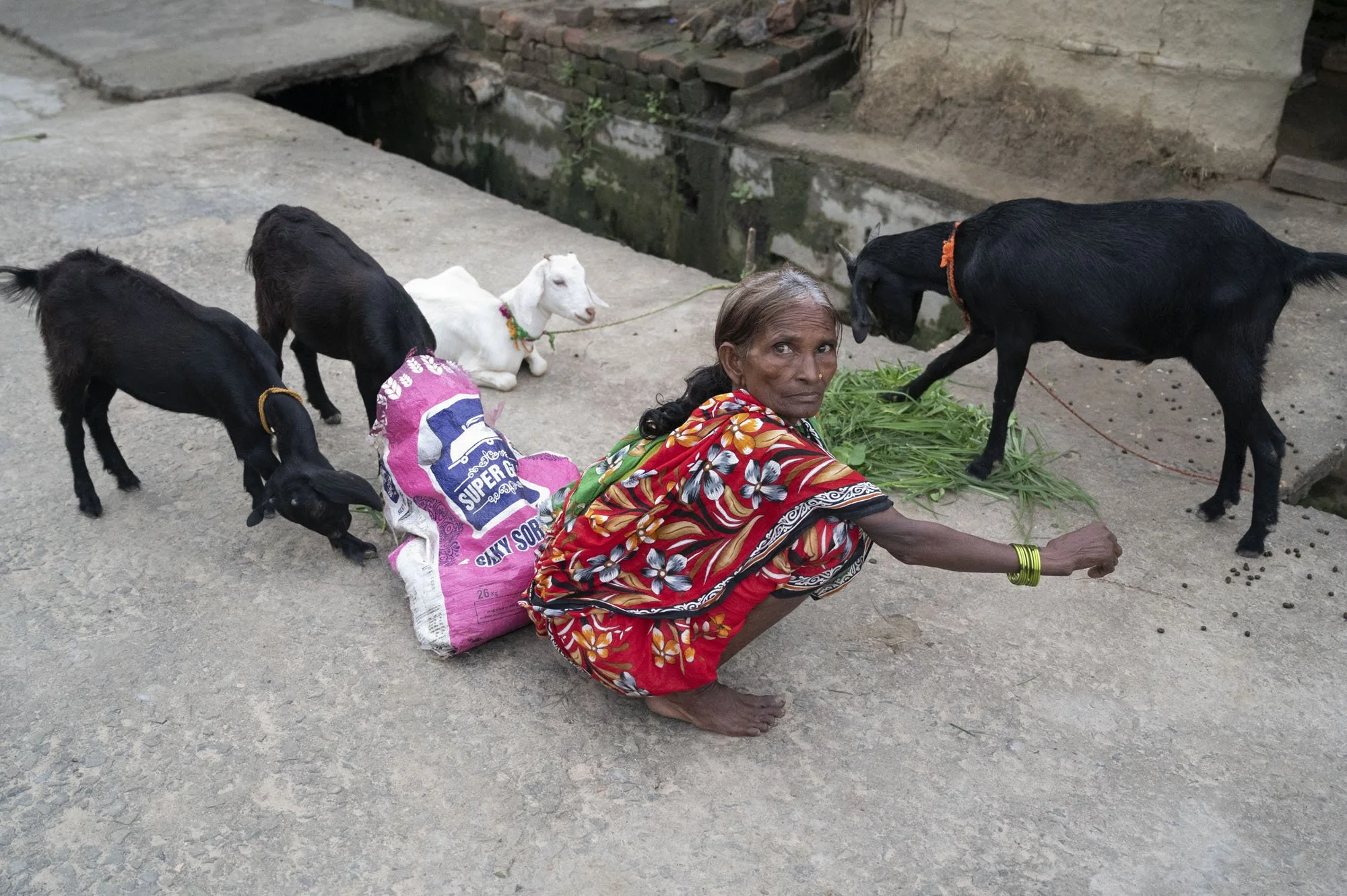
So what did they do? Buy goats! You can get 4 for 10,000 rupees. A great investment in Bihar when selling a goat can help you survive the harshest of economic times.
One woman, 40 year-old Putul Devi, did use the cash to set up a tea stall. It added to her already diverse enterprises – buying and selling goods for each religious festival and traveling to the places where they would sell best. She spotted that setting up a chai shop right outside the hospital would bring her good trade. Convenient too for her elderly father, installed behind the chai making equipment, who might one day need cataract surgery. Jugaad all round!
Lucy Mathen
#jugaad #smallisbeautifulandlocal #growthmania #goats #secondsight